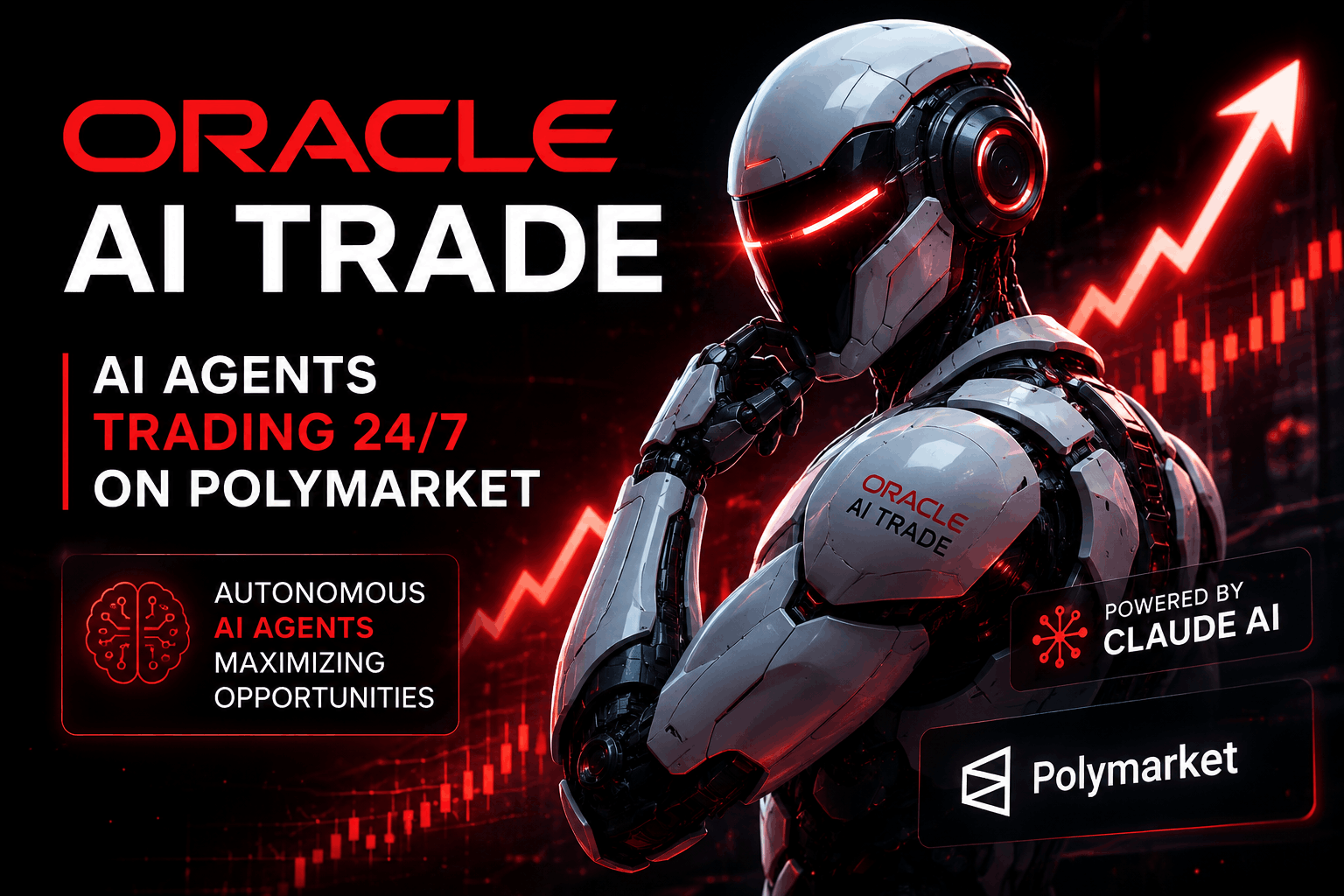
A new platform called Oracle AI Trade has been spreading across X over the past day, promising that a “swarm” of AI agents will trade your money around the clock on Polymarket and pay out fixed returns of up to 200% every 24 hours. The announcement has all the markings of a major launch: a nine-figure assets-under-management claim, more than a thousand markets supposedly being tracked in real time, and the now-familiar “position yourself early” call to action.
Oracle AI Trade (@ORACLEAIFND) June 11, 2026
If you’re reading this because you saw that post and you’re wondering whether Oracle AI Trade is worth your money, you’re asking exactly the right question before doing anything else. This review walks through what the platform actually claims, checks those claims against how real trading and real Artificial Intelligence agents work, and lays out the specific red flags worth knowing, not just for Oracle AI Trade but for the next platform that uses the same playbook.
Oracle AI Trade is a newly launched platform that claims AI agents trade Polymarket prediction markets and pay investors a “fixed yield” of 30% to 200% per 24-hour cycle, depending on deposit size.
A guaranteed, fixed return from an activity that’s inherently variable (trading) is the defining structure of a high-yield investment scheme, and a 200% daily rate is mathematically incompatible with any sustainable real-world strategy, as the numbers below make clear.
What Is Oracle AI Trade?
The Pitch, in Its Own Words
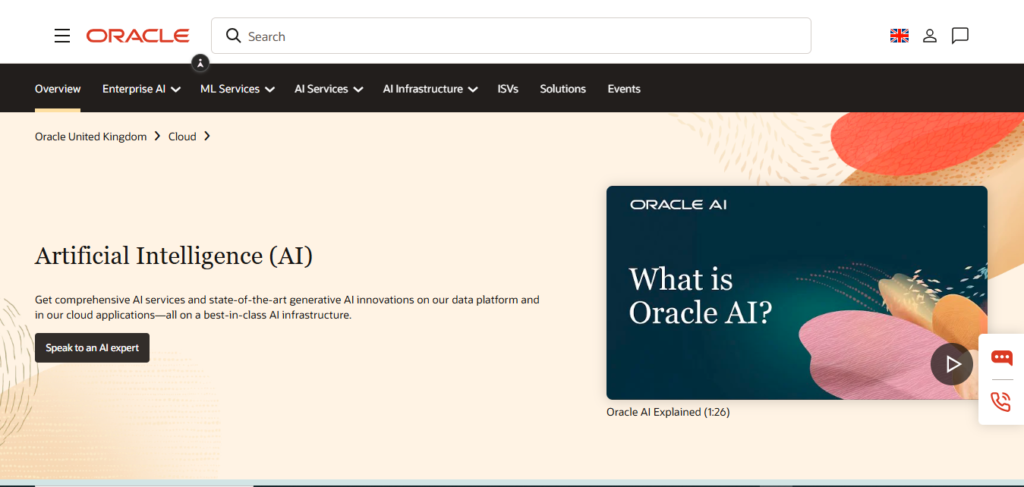
According to its website and recent posts on X, Oracle AI Trade (operated by an account using the handle @ORACLEAIFND) describes itself as a “swarm” of AI trading agents, built using Claude Code, that continuously analyze Polymarket prediction markets across politics, crypto, sports, and global events. The pitch claims these agents process “smart money” wallet activity, news flow, and on-chain data to find pricing inefficiencies, then trade with “built-in risk management.”
The platform states that it currently has more than $118 million under management and is actively tracking over 1,240 markets. It also lists a set of institutional-sounding security claims: capital held in segregated cold storage via Fireblocks with multi-signature controls, “regular on-chain attestations,” and SOC 2 compliance.
How the “Tiers” Work
Oracle AI Trade advertises six investment tiers, with minimum deposits ranging from $1,000 to $30,000. Each tier comes with its own advertised “fixed yield,” starting around 30% for the entry-level tier and climbing to 200% for the top “Diamond” tier, calculated on every completed 24-hour cycle. The platform also describes a 20% performance fee, charged only on profits above a “high-water mark,” and says funds can be withdrawn at any time.
On the surface, this reads like a fairly standard pitch for an automated trading fund: tiered access, performance fees, custody language. The problem isn’t the vocabulary. It’s the number sitting in the middle of it: 200% per day, fixed.
The Math Behind “Up to 200% Daily”: Why It Doesn’t Add Up
What “200% Yield” Actually Means
In finance, a “yield” of X% means you earn X% of your principal as profit. A 200% yield on a 24-hour cycle means that for every $1,000 you deposit, the platform claims to generate $2,000 in profit (tripling your money) every single day, with that profit “fixed” regardless of how the underlying markets actually move that day.
That’s the part worth sitting with: not “up to 200% over a year,” not “200% in a good month.” It’s 200%, every 24 hours, as a fixed and repeatable outcome.
Where $1,000 Goes in Two Weeks
Because each cycle multiplies your balance by roughly 3x (your original deposit plus a 200% gain), the growth compounds extremely fast. Starting with $1,000 at the top tier:
- Day 1: $3,000
- Day 3: $27,000
- Day 5: $243,000
- Day 7: $2,187,000
- Day 10: $59,049,000
By day 10, a single $1,000 deposit would be worth more than the entire $118 million the platform claims to manage in total. Extend that out to two weeks, and the number crosses into the billions: more money than exists in most national economies, generated from a single retail deposit.
For comparison, professional trading operations measure exceptional performance in annual percentages, not daily multiples. A year with a 30% return would be an exceptional one for most funds. AI-driven arbitrage bots on Polymarket are built to capture small, short-lived pricing gaps, often a fraction of a percent up to a few percent per trade, not per day, and certainly not as a “fixed” guarantee.
(The table below shows what the claimed top-tier rate does to a $1,000 deposit.)
| Day | Account Value |
|---|---|
| 0 | $1,000 |
| 1 | $3,000 |
| 3 | $27,000 |
| 5 | $243,000 |
| 7 | $2,187,000 |
| 10 | $59,049,000 |
| 14 | $4,782,969,000 |
Red Flag #1: Fixed Returns From an Activity That’s Inherently Variable
This is the single biggest tell, and it’s worth understanding because it shows up in almost every high-yield investment scheme, regardless of the buzzwords wrapped around it.
Real trading, whether it’s done by a human, a simple bot or a sophisticated AI agent, produces results that vary day to day. Some days are profitable, some are flat, and some lose money. That’s not a flaw; it’s what trading is. A platform that pays out a fixed percentage “on every completed cycle,” independent of how its trades actually performed, isn’t describing a trading strategy. It’s describing a payout schedule.
Payout schedules that don’t depend on underlying performance have to be funded from somewhere. In a legitimate fund, performance fees come from actual profits; there’s nothing to distribute on a losing day. In a high-yield scheme, “yields” are instead paid out of new deposits coming in from other investors. This works, visibly, for as long as new money flows in faster than it’s promised back out. It stops working the moment that reverses, and at a 200% daily payout rate, that moment arrives very quickly.
More Red Flags Worth Checking
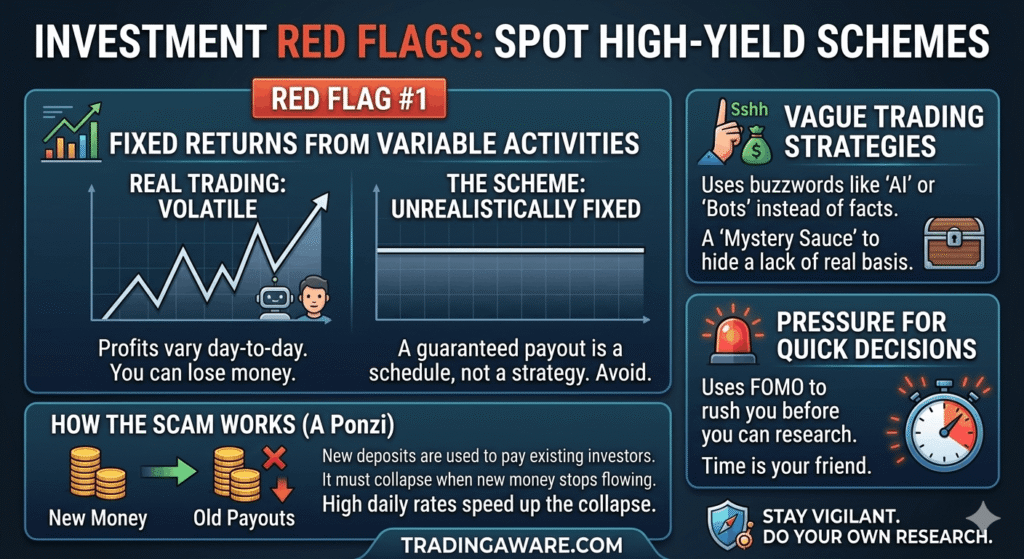
A Brand-New Domain and Social Account
Oracle AI Trade’s website and its @ORACLEAIFND account on X both appear to be recently created, with the “official launch” announcement posted within the last day. A brand-new domain and a brand-new account with no track record means there’s nothing to verify against: no history of past payouts, no community of long-term users, no public record beyond the platform’s own claims.
Unverifiable “Assets Under Management” Claims
The $118 million figure, the 1,240 tracked markets, and the live “dashboard” mentioned in the platform’s marketing are all numbers asserted by the platform about itself. None of this is the same as a third-party audit, a regulatory filing, or an on-chain wallet that’s been independently verified and linked to the claimed activity. Anyone can put a large number on a webpage.
Borrowed Credibility: “Claude-Powered” and Compliance Buzzwords
Oracle AI Trade describes its agents as “powered by Claude Code,” and its security section name-drops Fireblocks, multi-signature wallets, on-chain attestations, and SOC 2 compliance. These are all real terms used by legitimate companies in the crypto and AI industries, which is exactly why they show up in marketing copy for platforms that have no relationship with any of them.
To be specific: Anthropic, the company that builds Claude, does not operate, partner with, audit, or endorse third-party investment platforms. A platform stating that its agents are “powered by Claude” is making a claim about the AI model it allegedly uses to write code or generate text. It isn’t a certification, partnership, or guarantee from Anthropic about the platform’s legitimacy, security, or returns. The same logic applies to “SOC 2 compliant”: that’s a real auditing standard, but naming it on a webpage isn’t the same as having a current report from an actual auditor that a user can request and verify.
Urgency Language and Tiered Minimum Deposits
Phrases like “position yourself early,” paired with a tier structure that rewards larger deposits with proportionally larger “yields” (30% for $1,000, up to 200% for $30,000), serve a specific purpose: they push people toward depositing more, faster, before they’ve had time to research. Legitimate investment products don’t typically need to create time pressure; the opportunity doesn’t usually disappear if you take a day to do due diligence.
How Legitimate AI-Driven Trading Actually Performs
None of this means AI agents trading on platforms like Polymarket is fake or impossible. It’s a real and growing area. What’s misrepresented here is the scale of returns.
Automated prediction-market trading usually means bots that scan thousands of markets for small mispricings: situations where a contract is trading at, say, 98 cents when the “true” probability suggests it should be closer to 100 cents. Capturing that 2-cent gap on a $10,000 position might yield a couple of hundred dollars, after fees, when the market resolves. These opportunities are real, but they’re small, they don’t occur in every market every day, and they require careful risk management around resolution timing and platform fees.
Scale that up across many markets, and a skilled operator might post genuinely good returns over a month or a year. What no operator, human or AI, can do is convert that into a fixed, guaranteed, compounding 200% return every 24 hours. The two ideas (small recurring edges vs. guaranteed exponential daily multiplication) aren’t the same strategy at different sizes; they’re fundamentally different claims.
How to Verify Any Investment or Trading Platform Before You Invest
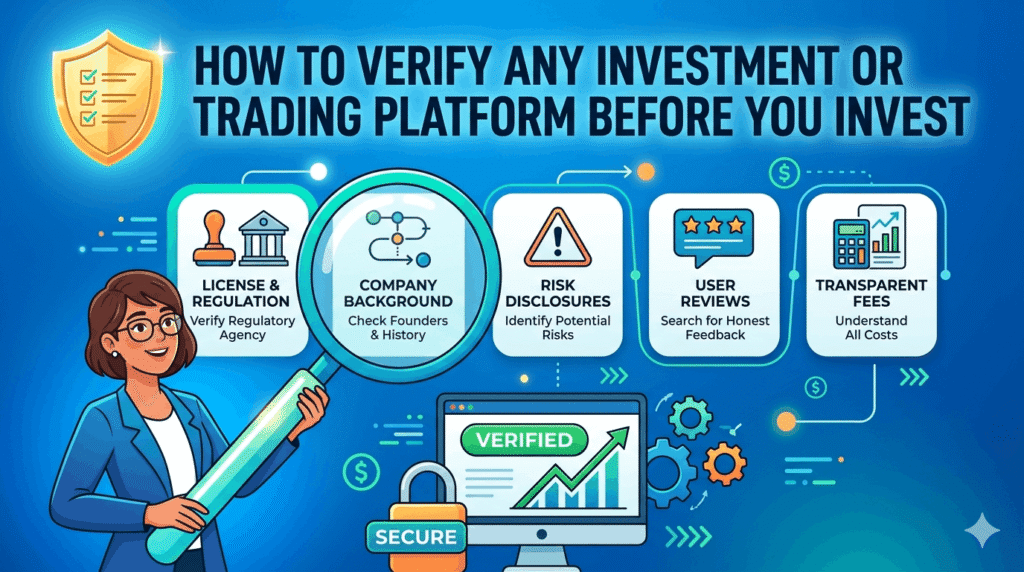
Before depositing money into any platform that promises trading-based returns, check for registration with the SEC or CFTC, independently confirm any named custody, audit, or technology partnerships by contacting those companies directly, and treat any fixed or guaranteed return (especially from “trading”) as a reason to stop, not a reason to hurry.
A few concrete steps that apply to Oracle AI Trade or any similar platform:
- Search regulatory databases. In the US, check the SEC’s EDGAR system and FINRA’s BrokerCheck for any registration. Platforms offering investment products to US residents generally need to be registered somewhere.
- Verify partnerships directly. If a platform claims to use Fireblocks, Claude, or any other named company’s product, that company’s own site or support channels can usually confirm whether a real partnership exists.
- Look for independent, dated audits. A “live dashboard” controlled entirely by the platform isn’t independent verification. Look for audit reports from named third-party firms, with dates and report numbers you can follow up on.
- Check the domain and account age. A WHOIS lookup shows when a domain was registered. A site claiming $118 million under management that’s only days old is a mismatch worth noticing.
- Run the math yourself. Any time you see a fixed daily, weekly, or monthly percentage, compound it for a month and see what number comes out. If the answer is “more money than exists,” that’s your answer.
If You’ve Already Sent Money to a Platform Like This
If you’ve already deposited funds, the most important step is to stop sending more, including in response to any message claiming you need to pay a “fee,” “tax,” or “verification deposit” to withdraw your funds. That request is itself a common follow-up scam targeting people who’ve already invested.
Document everything you can: screenshots of the platform, transaction records, wallet addresses, and any communications. In the US, you can file a report with the FTC at reportfraud.ftc.gov and with the FBI’s Internet Crime Complaint Center (IC3) at ic3.gov. If you purchased crypto through an exchange to fund the deposit, that exchange’s support team may also be able to flag the receiving wallet. Reporting doesn’t guarantee recovery, but it helps investigators identify and act on patterns across victims.
The Bigger Picture: AI Agents and Prediction Markets in 2026
AI-driven trading on prediction markets is a fast-growing space, and platforms are experimenting with autonomous agents that analyze markets, news, and on-chain data continuously. That real momentum is exactly what makes this an attractive area for high-yield schemes to attach themselves to. The underlying trend is real, the technology terms are real, and a specific platform’s claims about its own performance can still be entirely fabricated.
As more “AI agent trading” platforms launch over the coming months, the same checklist applies: read past the technology buzzwords to the actual financial structure being offered, and treat any fixed, guaranteed, or “up to” daily percentage as the thing to investigate first, not the headline to get excited about.
The Takeaway
Oracle AI Trade’s pitch is built for this moment: AI agents, Polymarket, a nine-figure number, and a countdown to “position yourself early.” But the platform’s central promise, a fixed yield of up to 200% on every 24-hour cycle, fails basic compounding math within days and matches the well-documented structure of high-yield investment schemes rather than any real trading operation.
That doesn’t mean AI-driven trading on prediction markets is fake as a category. It’s a real and active area. It means this specific set of claims should be checked against regulatory databases, independent audits, and simple arithmetic before a single dollar moves, and that “powered by” a well-known AI model is marketing language, not a guarantee from the company behind that model.
FAQs
What is Oracle AI Trade?
Oracle AI Trade is a platform promoted on X from June 2026 that claims AI agents trade Polymarket prediction markets and pay a fixed yield of 30% to 200% every 24 hours. Fixed daily returns like that match the pattern of a high-yield investment scheme, not a real trading fund.
How does Oracle AI Trade work?
According to its own marketing, deposits of $1,000 to $30,000 go into tiers that each promise a fixed daily yield. None of its figures, including the claimed $118 million under management, has been independently verified, and a fixed payout from variable trading results cannot be funded by trading alone.
Is Oracle AI Trade suitable for beginners?
No. A platform promising fixed returns of up to 200% a day is not suitable for anyone. If you have already deposited money, stop sending more, keep records, and report it at reportfraud.ftc.gov and ic3.gov if you are in the US.
What markets does Oracle AI Trade analyze?
The platform focuses on prediction markets involving politics, cryptocurrencies, sports, economic events, and global developments.
Can AI trading systems guarantee profits?
No. AI trading systems can improve analysis and automation, but they cannot eliminate market risk or guarantee returns.
Why are prediction markets important for AI trading?
Prediction markets provide structured probability-based data that AI systems can analyze to identify potential pricing inefficiencies.
What should investors verify before using Oracle AI Trade?
Investors should verify company transparency, security measures, risk disclosures, operational details, and performance claims before investing.