Artificial intelligence is rapidly transforming how people search for information online. Instead of clicking through multiple websites, users now rely on AI-powered tools to deliver direct, summarized answers. Platforms like ChatGPT, Google Gemini, and Perplexity AI are changing the rules of visibility.
This shift introduces a new challenge for brands: how to appear inside AI-generated answers instead of just ranking on Google.
If your content is not optimized for AI-driven search engines, your brand risks becoming invisible—even if you rank well on traditional search engines.
In this comprehensive guide, you’ll learn exactly how to improve brand visibility in AI search engines, using proven strategies based on semantic SEO, entity optimization, and generative search behavior.
Improving brand visibility in AI-driven search engines requires optimizing content for entities, authority, and structured answers. AI tools prioritize trustworthy sources, semantic relevance, and clear information. Brands that build topical authority and provide high-quality, structured content are more likely to be cited in AI-generated responses.
What Are AI Search Engines?
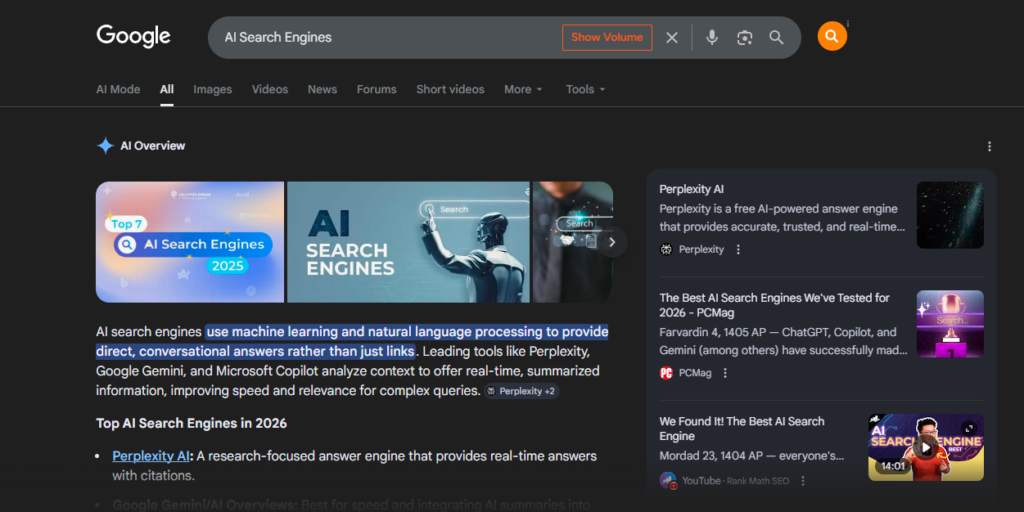
AI search engines are platforms that use large language models (LLMs) to generate direct answers instead of showing a list of links.
Unlike traditional search engines, these tools:
- Understand context, not just keywords
- Combine multiple sources into one answer
- Prioritize authority and trust signals
- Often create zero-click search experiences
Examples include:
- ChatGPT
- Perplexity AI
- Bing Copilot
👉 Key difference:
Traditional SEO helps you rank.
AI SEO helps you get mentioned in answers.
How AI Search Engines Rank Content
To understand how to improve brand visibility in AI search engines, you must first understand how they rank and select information.
AI models rely on several core signals:
1. Entity Recognition
AI identifies brands, people, and topics as entities. If your brand is not recognized as an entity, it is less likely to appear in responses.
2. Semantic Relevance
AI does not rely on exact keywords. It analyzes:
- Topic depth
- Context
- Relationships between concepts
3. Authority Signals
AI prioritizes trusted sources. This includes:
- Backlinks
- Mentions across the web
- Domain authority
4. Structured Information
Content that is clearly organized is easier for AI to extract and summarize.
What Is Generative Engine Optimization (GEO)?

Generative Engine Optimization (GEO) is the next evolution of SEO.
It focuses on optimizing your content so it can be used inside AI-generated answers, not just ranked in search results.
GEO vs Traditional SEO
| Factor | Traditional SEO | AI SEO (GEO) |
|---|---|---|
| Goal | Rank on Google | Appear in AI answers |
| Focus | Keywords | Entities & context |
| Traffic | Click-based | Zero-click visibility |
| Content Style | Blog-focused | Answer-focused |
👉 Insight:
GEO is not replacing SEO—it is expanding it.
Proven Strategies to Improve Brand Visibility in AI-Driven Search Engines
1. Build Strong Topical Authority
AI prefers sources that demonstrate deep expertise.
To achieve this:
- Create content clusters around a niche
- Publish multiple related articles
- Cover topics in depth
Example:
Instead of one article on AI SEO, publish:
- AI SEO basics
- Generative search optimization
- AI content ranking factors
👉 This signals expertise to AI systems.
2. Optimize for Entities, Not Just Keywords
Entity-based SEO is critical for AI visibility.
You should:
- Mention your brand consistently
- Associate your brand with specific topics
- Use structured data (schema markup)
For example:
- Link your brand with terms like “AI SEO expert” or “data tools platform.”
- Get listed on authoritative platforms
3. Create Structured, AI-Friendly Content
AI prefers content that is easy to extract.
Use:
- Clear headings (H2, H3)
- Short paragraphs
- Bullet points
- Direct answers
👉 Important:
Write content that answers questions immediately and clearly.
4. Target Conversational and Long-Tail Queries
AI search is conversational.
Instead of targeting:
- “AI SEO”
Target:
- “How to improve brand visibility in AI search engines.”
- “How to rank in AI search results.”
These queries match how users interact with AI tools.
5. Increase Brand Mentions Across the Web
AI systems learn from multiple sources.
To improve visibility:
- Get featured in blog posts
- Publish on platforms like Medium
- Engage in communities (Reddit, Quora)
- Build backlinks
👉 The more your brand is mentioned, the more AI trusts it.
6. Focus on E-E-A-T Signals
E-E-A-T stands for:
- Experience
- Expertise
- Authoritativeness
- Trustworthiness
To improve these:
- Show author credentials
- Add real examples
- Include data and insights
- Keep content accurate and updated
AI systems heavily rely on these signals.
7. Optimize for Zero-Click Search
AI search often eliminates clicks.
To benefit from this:
- Ensure your brand name appears in answers
- Write memorable, quotable insights
- Create unique frameworks or concepts
👉 Goal:
Make AI mention your brand, not just use your content.
8. Use Internal Linking Strategically
Internal linking builds topical authority.
For example:
- Link related articles together
- Use keyword-rich anchor text
- Create content hubs
This helps both search engines and AI understand your site structure.
9. Publish Data-Driven and Original Insights
AI prefers unique information.
Instead of repeating common knowledge:
- Share case studies
- Publish original data
- Provide expert opinions
👉 Original content increases chances of being cited.
10. Optimize Technical SEO for AI Crawling
Technical SEO still matters.
Ensure:
- Fast loading speed
- Mobile-friendly design
- Clean HTML structure
- Proper schema markup
These factors improve accessibility for AI systems.
Common Mistakes to Avoid
Many websites fail to appear in AI search results because of these mistakes:
- Writing generic content
- Ignoring entity SEO
- Overusing keywords
- Lack of authority signals
- Poor content structure
👉 Fixing these can significantly improve visibility.
Future of Brand Visibility in AI Search
The future of search is shifting toward:
- AI Overviews
- Voice search
- Conversational interfaces
- Personalized AI assistants
Companies like Google, Microsoft, and OpenAI are heavily investing in AI search.
This means:
- Competition will increase
- Early adopters will gain an advantage
Final Thoughts
Learning how to improve brand visibility in AI search engines is no longer optional—it is essential.
Traditional SEO alone is not enough. You must adapt to how AI systems understand, evaluate, and present information.
Focus on:
- Building authority
- Creating structured content
- Optimizing for entities
- Providing real value
The brands that succeed in AI search will not just rank—they will become trusted sources that AI relies on.
Start optimizing now, and you position your brand ahead of the competition in the next era of search.
FAQs
1. How to improve brand visibility in AI search engines?
To improve brand visibility in AI search engines, focus on creating high-quality, structured content, building topical authority, optimizing for entities, and increasing brand mentions across trusted websites.
2. What is AI search engine optimization (AI SEO)?
AI SEO is the process of optimizing content so it appears in AI-generated answers from tools like ChatGPT and Perplexity AI, rather than just ranking in traditional search results.
3. How do AI search engines rank content?
AI search engines rank content based on semantic relevance, authority, structured data, and entity recognition instead of just keywords and backlinks.
4. What is Generative Engine Optimization (GEO)?
Generative Engine Optimization (GEO) is a modern SEO strategy focused on getting your content cited and used in AI-generated responses instead of only ranking on search engine result pages.
5. Why is brand visibility important in AI search?
Brand visibility in AI search is important because users increasingly rely on AI-generated answers, and being mentioned in those responses builds trust, authority, and long-term traffic opportunities.