Perplexity AI’s Trustpilot page told a different story in January than it does now. Back then the score sat at 1.7 out of 5. Checked again this week, it’s 1.4, out of 803 reviews, and 83% of those reviews are one star. That is not what a clean safety verdict usually looks like.
Our take: Caution. Perplexity AI is a real, well-funded search engine, not a scam site dressed up to look legitimate. But between a privacy lawsuit that came and went in about a month, refund windows as short as 24 hours in most countries, and a steady stream of billing complaints, it is not a tool to sign up for on autopilot.
What “safe” actually covers here
Perplexity AI is a real AI-powered search and answer engine built on large language models plus live web sources, and it is not disguised malware or a clone app. It is publicly accessible, backed by real venture funding, and covered in detail on Wikipedia. So when people ask if it is “safe,” they are rarely asking whether it is fake. They usually mean one of three things: does it mishandle my data, can I trust its answers, and will it be a hassle to cancel if I pay for it. Those three questions get very different answers, and that is worth working through instead of a simple yes or no. General background on AI search tools, including how they compare to a broader browser like Comet AI, is covered in our other reviews if you are comparing options.
The lawsuit that came and went
On March 31, 2026, a proposed class action was filed against Perplexity AI, Meta, and Google in the U.S. District Court for the Northern District of California, later captioned Noel v. Perplexity AI, Inc., case number 3:26-cv-02803. The complaint alleged that Perplexity had embedded Meta Pixel, Meta Conversions API, Google Ads, and Google DoubleClick trackers that sent users’ chat prompts, AI responses, email addresses, and IP addresses to Meta and Google, allegedly even in the platform’s Incognito mode. It cited California’s wiretapping law (CIPA) and the federal Wiretap Act among other claims.
A Perplexity spokesperson told reporters the company had not been served and could not verify the claims. The case did not get far: the plaintiff voluntarily dismissed it without prejudice on May 1, 2026, and it was closed on May 6. No class was ever certified and no judge ruled on whether the allegations were true. That cuts both ways: nothing was proven, but nothing was disproven either, and the underlying tracking pixels were never independently confirmed or denied in court.
What the 1-star reviews actually say
The Trustpilot complaints cluster around a handful of repeat themes rather than random noise, which is usually a sign the pattern is real. Reviewers describe subscriptions that come with a limited pool of “credits” that drain fast, pushing paying users toward extra purchases. One reviewer summed it up bluntly: “They bait you into a subscription and then immediately start draining hidden ‘credits’ for essential tasks.” Other recurring complaints: slow or unreachable human support, noticeable quality drop-off in answers over time, and refund requests denied even when they were filed inside the stated window.
Data handling: what is routine and what to avoid
Setting the lawsuit aside, Perplexity runs as a normal web service and mobile app. It does not ask for invasive device permissions and does not run hidden background processes. Like most AI platforms, it logs queries and usage patterns to improve the product, which is standard SaaS behavior rather than covert data harvesting on its own.
Given the tracking-pixel allegations above, treat the chat box the way you would any web form you do not fully control. Avoid typing in:
- Private personal information
- Confidential business data
- Exam questions or proprietary documents
None of this is unique to Perplexity. It applies to every generative AI chat tool on the market right now.
Refund windows, by region
| Where you are | Monthly plan | Annual plan |
|---|---|---|
| EU, UK, or Turkey | 14 days | 14 days |
| South Korea or Brazil | 7 days | 7 days |
| Everywhere else | 24 hours | 72 hours |
That “everywhere else” row is the one to remember: a 24-hour window on a monthly plan does not give you much room to change your mind. According to Perplexity’s own refund policy, processing can take one to two days beyond the window, a second refund request will not be honored once a first one is granted, and an account terminated for a Terms of Use violation forfeits its refund. To cancel on the web or mobile browser, go to perplexity.ai/pro, select “Manage Subscription,” then “Cancel Plan,” and pick the refund option if you are inside the window. On the App Store, use reportaproblem.apple.com; on Google Play, go to Help > Contact Support inside the app. We have not confirmed these flows still match exactly, so check the current screen before you rely on them.
On mobile, and through third-party bots
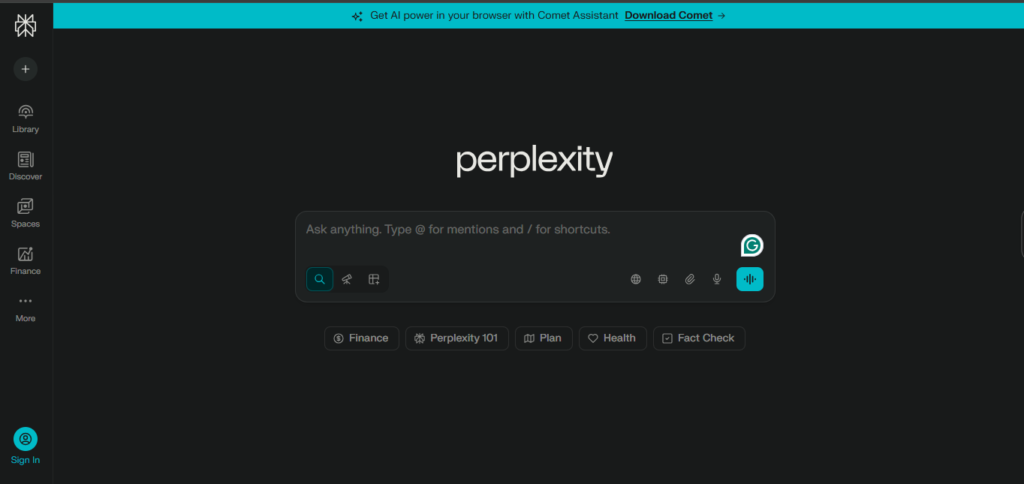
The official Perplexity app for Android and iOS follows normal app store security practices and does not request unusual permissions. The risk shows up with unofficial bots on WhatsApp or Telegram that claim to run on Perplexity. Those are not affiliated with the company, and anything you type into them is not covered by Perplexity’s own privacy policy at all.
For students specifically
Perplexity is genuinely useful for research, brainstorming, and getting a fast overview of a topic, and its source citations make it easier to check claims than a plain chatbot. The risk for students is not malware, it is academic consequences: submitting AI-generated work without disclosure can violate a school’s policy regardless of how the tool markets itself. Treat it as a research assistant, not a ghostwriter.
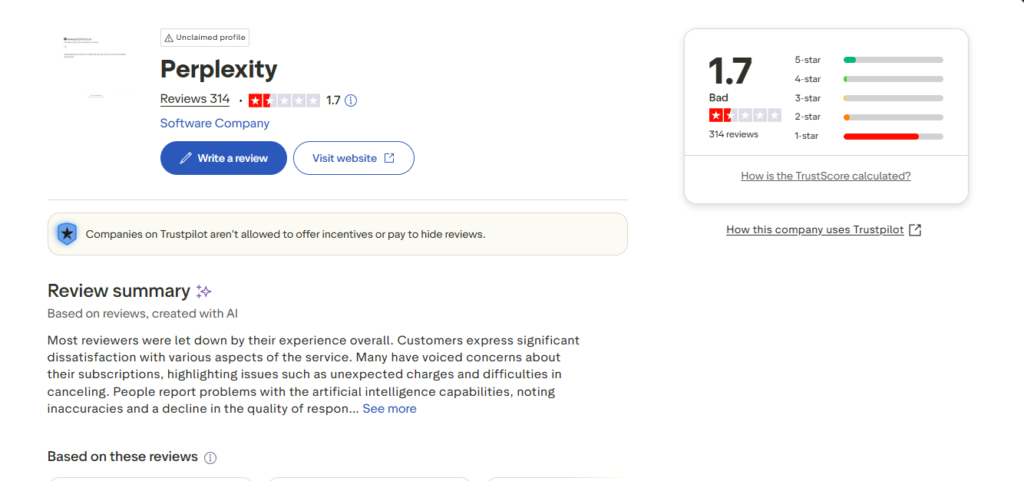
The screenshot above is from January, when the score was 1.7. It has only gotten worse since, which suggests this is not a one-off dip. If you are weighing Perplexity against writing-detection worries too, our review of Undetectable AI covers a related angle of the same academic-honesty question.
How it compares to ChatGPT on safety, briefly
Perplexity’s source citations reduce hallucination risk compared with a plain chatbot, but they do not eliminate it, and citations do not make the company inherently safer on privacy than any other major AI tool. No mainstream AI assistant can guarantee both accuracy and privacy at the same time. Safety here comes as much from how you use the tool as from how the company built it. If you are exploring alternatives more broadly, our guide to JustDone AI walks through a similar trust question for a different AI writing tool.
Who it actually works for
Good fit:
- Researchers who want a fast, sourced starting point
- Students gathering references, not final drafts
- Professionals summarizing background reading
- Writers who want to fact-check quickly
Skip it, or be careful, if you:
- Plan to enter confidential or sensitive data
- Need a guaranteed-accurate answer for a compliance or legal question
- Are outside the EU, UK, Turkey, South Korea, or Brazil and might want a refund after the first day
- Already have a low tolerance for subscription billing friction
There is a free tier with no card required, which is the lowest-risk way to see if the tool fits your workflow before any billing question becomes relevant.
How we checked this
We read Perplexity’s current Trustpilot page and its official refund help center article on September 28, 2026. The lawsuit details come from a Claims Journal news report on the filing and a case-tracking summary of the docket (case 3:26-cv-02803, N.D. Cal.), not from the original court filing itself.
We did not create a Perplexity account or test its paid features first-hand for this update, and we could not independently verify whether the tracking pixels named in the now-dismissed lawsuit are still active.
Prices, plans and features change often. Check the official site before you pay. Datalevo isn’t affiliated with or paid by any company mentioned here. Research and drafting were AI-assisted, and every figure was checked against the linked sources. Our full process is on the How We Review page.
FAQs
Is Perplexity AI safe to use?
It’s a real, legitimate AI search engine, not a scam. It’s not malware and doesn’t request unusual device permissions. The caution is around billing, refunds, and a dismissed but unresolved privacy lawsuit, not around the app being fake.
Is Perplexity AI a scam?
No. It’s a venture-backed company with a public track record. “Scam” isn’t the right word here; “a real product with real complaints” is more accurate, especially around its credit system and refund process.
Why is Perplexity AI’s Trustpilot rating so low?
As of late September 2026 it sits at 1.4 out of 5 from 803 reviews, with 83% one star. The most common complaints are about credits draining fast, slow support, declining answer quality, and denied refund requests.
Did Perplexity AI share user data with Meta and Google?
A class action filed in March 2026 alleged that tracking pixels sent chat data to Meta and Google, even in Incognito mode. The plaintiff dropped the case about a month later with no ruling on the merits, so the allegation was never proven or disproven in court.
How do I get a refund from Perplexity AI?
It depends where you live. The EU, UK, and Turkey get 14 days; South Korea and Brazil get 7 days; everywhere else it’s 24 hours on monthly plans and 72 hours on annual plans. Cancel through “Manage Subscription” on perplexity.ai/pro, or through your app store’s support channel.
Is Perplexity AI safe for students?
It’s fine for research and gathering sources, since it shows citations you can check. It’s risky if you submit its output as your own work without disclosure, which can violate school policy no matter how the tool is marketed.