For at least five weeks this summer, more than 144,000 chat logs from the AI app 302.AI sat in an online storage bucket that anyone with the address could open. No password. No encryption. Researchers at Cybernews found it on 2 August 2026 and saw it closed on 8 September.
If you’ve used 302.AI, assume your prompts, the AI’s answers and any files you uploaded may have been seen by someone. There’s no evidence yet that criminals copied the data. There’s also no way for you to prove they didn’t, and the company hasn’t said anything publicly.
The leak became public on 22 October, when TechRadar picked up the Cybernews findings. Below: what was exposed, what 302.AI’s own privacy policy says (it’s stranger than the leak), and the steps worth taking this week.
What 302.AI is, and what leaked
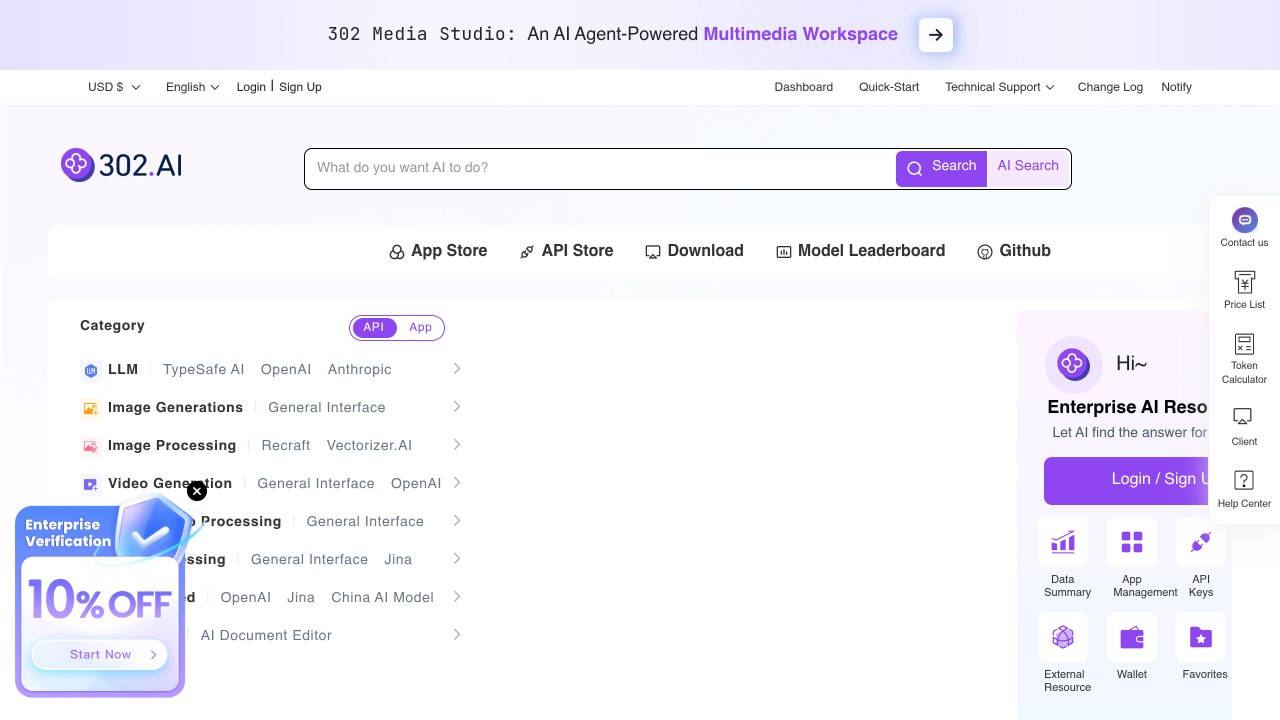
302.AI is an AI aggregator. Instead of paying OpenAI, Anthropic and Google separately, you top up one wallet and pick a model from a menu. When we checked its homepage on 23 October, that menu covered OpenAI, Anthropic, Gemini, Grok, DeepSeek, Meta, Mistral and a long list of Chinese model makers, plus image, video and audio tools. Cybernews says it’s built by Univerads Technology Limited, a Hong Kong company founded in 2020.
The exposed bucket was hosted on Microsoft Azure. Here’s what the researchers counted inside it:
| What was exposed | How much |
|---|---|
| Files in total | 17.6 million (22.72TB) |
| Images | Nearly 9TB |
| Video | 7.7TB |
| Audio | 5.6TB |
| Chat logs (prompts, replies, model used, token cost, timestamps) | Over 144,000 files |
| Archived conversations, including files users shared | Over 26,000 zip files |
Some logs held personal details people had typed into their chats: birth dates, genders, contact details and home addresses. Businesses used the service too. Cybernews found research documents, private files sent in for analysis, and the support-chatbot logs of an adult product maker, which is how the story got its headlines.
Cybernews describes the exposure as most likely accidental. The data went offline after it contacted the company. The company didn’t reply to Cybernews. Nobody has said how long the bucket was open before August, or whether anyone else found it first.
The 302.AI privacy policy never mentions your chats
We read 302.AI’s privacy policy and terms of use on 23 October. Both are dated 22 September 2022. That’s more than two months before ChatGPT launched, for a service whose whole business is now chat.
It shows. The privacy policy covers your name, email, IP address and billing details. The words “chat,” “conversation” and “upload” don’t appear in it once. So there’s no stated rule for how long your prompts are kept, where they’re stored, or who can see them. The only retention promise is that personal information is kept “for as long as necessary to provide the Service.”
Then there’s the contact section. It tells anyone whose privacy was compromised to “contact Bright Data” at a 302.AI email address, and gives a Singapore street address. Bright Data is a different company, one that sells web data. We can’t tell you how its name ended up in 302.AI’s policy. It does tell you how closely anyone has read that document since 2022.
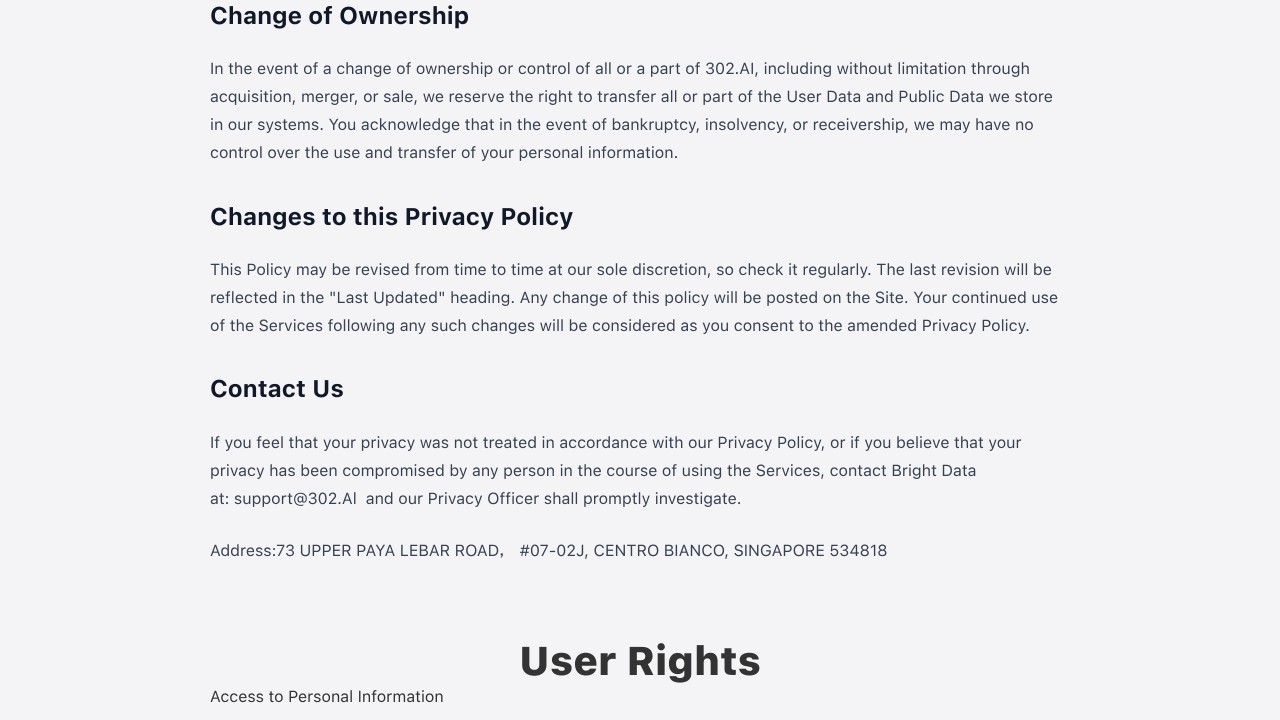
302.AI’s privacy policy (dated 22 September 2022) sends privacy complaints to “Bright Data.” Screenshot taken 23 October 2026.
Three more details stood out:
- The security section says the company uses industry-standard measures “to prevent information misuse and data leakage.” A few paragraphs later, a disclaimer says it’s “not responsible for the accuracy, correctness, and security” of the information it stores.
- Neither the privacy policy nor the terms names Univerads Technology Limited, or any company at all. The terms are an agreement with “the owner and operator of 302.AI.”
- The refund policy says wallet top-ups are non-refundable once credited, including if you simply no longer want the service. Refunds are only considered when a technical fault eats your credits.
None of this proves bad intent. It does mean that, on paper, 302.AI never promised its users much about their chats in the first place.
Used 302.AI? Do these four things this week
The real danger isn’t the leak itself. It’s what a scammer can do with a stranger’s chat history. A phishing email that mentions your actual project, your client’s name or the city you gave the AI is far more convincing than the usual spam. TechRadar and Cybernews both flag exactly this.
- Change anything you pasted into a chat. People paste passwords, API keys and database logins into AI tools to get help with code. If you did that on 302.AI, rotate those credentials today.
- Treat oddly specific emails with suspicion. If a message refers to something you only ever told an AI, don’t click its links or open its attachments, however real it looks.
- Ask for deletion in writing. The policy says deletion requests go to [email protected]. Send one from the email on your account, list the account and ask for your chat history, uploads and personal details to be deleted, plus confirmation once it’s done. Keep a copy. The policy lets the company ask you to verify your identity first.
- Stop topping up. Any balance you add can’t be refunded, so don’t add more until the company explains what happened.
If you used 302.AI through a work account, tell your IT or security team. Business files were in that bucket, and your employer may have its own reporting duties.
Why middleman AI apps carry extra risk
When you use ChatGPT directly, your words go to one company. Through an aggregator, they go to two: the app in the middle, and whichever model maker it forwards them to. The middle company is usually smaller, and nothing guarantees it keeps your data to the same standard as the big labs.
302.AI isn’t the only middleman with a bad week. On 19 October, The Hacker News reported that an intruder reached a legacy system at OpenCode, a coding tool, on 16 October. The company told affected users their saved OpenAI, Anthropic and Google API keys may have been exposed. It says 1.4% of its Console users were affected.
All-in-one AI apps are popular because they’re cheap and convenient, and plenty are run by real companies. We’ve reviewed several, including Use.AI, ChatOn and Magica, the app formerly called Galaxy AI. Even Venice, which markets itself on privacy, tells users on its own privacy page to assume the model provider stores what they send to some models. Our Venice AI review covers that gap.
A two-minute test for any all-in-one AI app
Before you hand an AI app anything personal, open its privacy policy and press Ctrl+F (Cmd+F on a Mac). Search for these:
- “chat,” “prompt” or “conversation.” If none appear, the policy wasn’t written for an AI product. 302.AI’s fails here.
- A retention period. Look for a number of days or months. “As long as necessary” isn’t one.
- A company name you can look up. If the policy and terms never say who you’re dealing with, you’ll struggle to complain or ask for deletion.
- The date. A policy older than the product’s AI features is a policy nobody has updated for them.
- Another company’s name. Copied boilerplate leaves fingerprints, as 302.AI’s “Bright Data” line shows.
If an app fails two of these, keep it to throwaway questions. Use the model maker’s own app for anything with your name, health, money or work in it.
FAQs
Was 302.AI hacked?
Not in the usual sense. Cybernews found an Azure storage bucket that was left open without a password, so anyone with the address could read it. There’s no public evidence that criminals downloaded it, but that can’t be ruled out.
What data was exposed in the 302.AI leak?
About 17.6 million files, including more than 144,000 chat logs and over 26,000 archived conversations. Some logs contained users’ names, birth dates, contact details and home addresses that they had typed into chats.
Is 302.AI safe to use now?
The open bucket was closed by 8 September 2026, according to Cybernews. But the company hasn’t explained the leak, and its privacy policy, last dated 2022, says nothing about how chats are stored. We wouldn’t put anything personal or work-related into it.
How do I delete my 302.AI data?
Its privacy policy says to email [email protected] with a verifiable request. Send it from your account email, ask for your chats, uploads and personal details to be deleted, and keep a copy of the message.
Can I get a refund from 302.AI after the leak?
Its refund policy says wallet top-ups are non-refundable once credited and only allows refunds for technical faults. Nothing in the policy covers a data leak, so don’t add more credit while you wait for answers.