
Venice AI sells itself as private, unrestricted AI. Open the privacy page on its own site, though, and one of its four privacy modes comes with a blunt instruction: “assume the provider is storing your content.” That mode covers the GPT, Claude and Gemini models offered inside Venice.
Our verdict is Caution. Venice is a real company with a privacy design that goes further than most chatbots: your chats are kept in your browser, and two paid modes can be checked with cryptography. It isn’t a scam. The cautions are that privacy changes with the model you pick, subscriptions are non-refundable, and its Trustpilot score sits at 1.8 out of 5.
Everything below was read on Venice’s own pages, Trustpilot and the US App Store on October 9, 2026. We didn’t open an account or pay for a plan, so nothing here is a test of how well the models answer.
What is Venice AI?
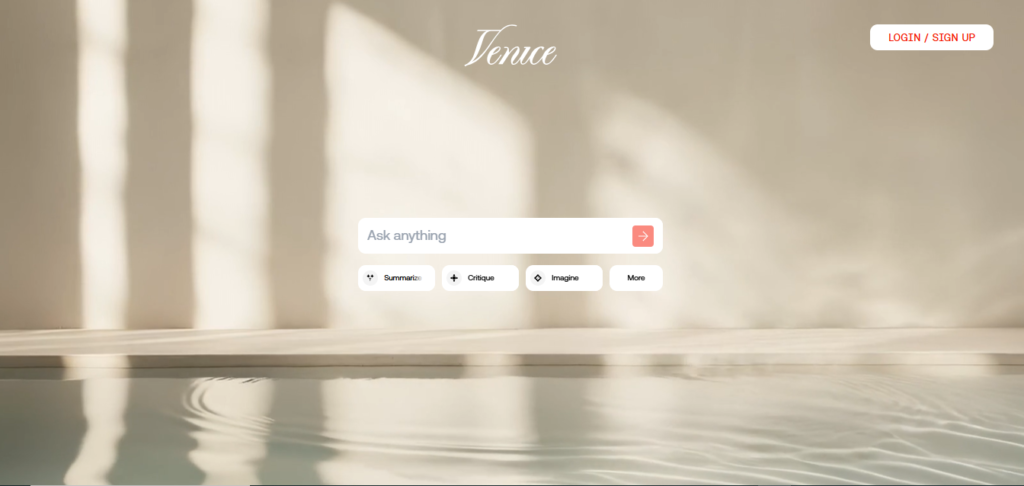
Venice AI is a chat, image, video and code generator at venice.ai, with iPhone and Android apps. The Block reported its launch in May 2024 by Erik Voorhees, the founder of the crypto exchange ShapeShift. The terms of service give a mailing address in Sheridan, Wyoming, and apply Wyoming law.
It differs from ChatGPT in two ways. Your conversation history stays in your browser and isn’t uploaded to Venice’s servers. And it offers open models with fewer content rules, which is where the “uncensored” label comes from. There’s a crypto side too (the VVV token and DIEM credits). You can ignore it if all you want is the chatbot.
Is Venice AI safe and private? Check the badge on the model
Every model in Venice carries one of four privacy badges. They aren’t equal, and Venice says so on its privacy page.
| Badge | Who gets it | What Venice says happens | What you are trusting |
|---|---|---|---|
| Anonymous | Every user | Your request is passed to an outside provider (GPT, Claude, Gemini) with your identity hidden. Venice tells you to assume the provider stores the content. | The outside provider and its own policy |
| Private (the default) | Every user | Runs on Venice-controlled GPUs or partners under a zero-retention contract. Nothing is stored. | Venice and its partners keeping their word. The page calls this trust-based. |
| TEE | Pro and above | Runs inside a sealed hardware enclave operated by NEAR AI Cloud and Phala Network, with an attestation you can check. | Hardware that can be verified |
| E2EE | Pro and above | The prompt is encrypted on your device and only decrypted inside a verified enclave. Web search and memory are switched off. | Cryptography, at the cost of slower answers |
So the strongest protection is a paid feature, and the famous-name models are the weakest option. If you came to Venice to use Claude or GPT privately, read the first row twice. Venice hides who you are from that provider. It can’t hide what you typed.
Venice AI privacy policy: what it collects, and one line that doesn’t match
The legal privacy policy (effective June 2, 2026) says Venice runs a zero data retention policy with its model providers, who are barred from keeping prompts longer than it takes to answer. The product page says to assume an Anonymous-mode provider is storing your content. We can’t tell you which statement holds for a given model. Plan around the more cautious one.
The policy also lists what Venice itself collects, and it’s more than nothing:
- With no account: your time zone, browser type and IP address.
- With an account: your email, or your wallet’s public key if you sign in with crypto.
- From your phone or computer: device identifiers, operating system, carrier and mobile advertising identifiers.
- Usage records, such as the fact that you created or deleted a chat. The policy says Venice doesn’t have access to what the chat said.
- Analytics through Google Analytics, plus cookies from advertising and security partners.
Card details go to the payment processor and aren’t shared with Venice, according to the same policy. It can disclose personal data to comply with law enforcement requests and court orders. And it includes the standard lawyer’s caveat that no guarantee can be made about the security or privacy of your data.
That’s still a shorter list than some rivals. ChatOn AI’s policy, for one, allows chat excerpts from free users to reach an ad partner. For medical, legal or client files the rule is simple: only E2EE keeps the prompt unreadable to everyone but you, and Venice’s terms say its outputs don’t replace advice from a qualified professional.
Your chats live in your browser, which cuts both ways
Local storage is the best part of Venice’s design. It’s also how people lose their history. Clear your browser data, change phones or open a different browser, and the chats aren’t there, because they were never on a server.
Venice’s FAQ gives two fixes. Turn on Persist Storage (chat history drawer, then Settings, then Storage and Limits). Or, on Pro, make an encrypted backup from the web app. You set the password and Venice keeps no copy of it. You can hold five backups, and each one expires after 90 days. Lose the password and the backup is gone for good.
One more thing. Anyone who sits down at your unlocked computer can open those chats. A shared family PC is not a private place for them.
Is Venice AI legit or a scam? Prices and the refund rule
It’s legit in the plain sense: a working product, a named founder, published terms and apps in both stores. Billing is where the word “scam” turns up in reviews, so here are the numbers from the pricing page.
- Free: 10 text prompts and 15 image prompts a day.
- Pro: $18 a month, or $180 for a year on the Yearly tab.
- Pro Plus: $68 a month. Max: $200 a month.
- Credits: video, music and frontier models are paid for in credits, at 100 credits to the dollar. Pro includes 100 a month.
The refund rule is short. Venice’s FAQ says subscriptions are generally non-refundable once payment has gone through, and the terms of service (last updated June 8, 2026) say all fees are non-refundable except where the law requires otherwise. Credits come back automatically only when a generation fails to produce anything. Credit plans reward careful reading, as our Pollo AI review found.
Check where you subscribe. The US App Store listing showed Venice AI Pro at $23.99 and $234.99, against $18 and $180 on the website. Pro Plus was $88 against $68, and Max $259 against $200. If the $23.99 line is the monthly plan, as the price suggests, a year of Pro bought through the iPhone comes to $287.88. That’s $71.88 more than paying monthly on the web.
Venice AI reviews: what the complaints are about
Venice’s Trustpilot page showed 1.8 out of 5 from 62 reviews: 46 one-star, 5 two-star, 4 four-star and 7 five-star. Sixty-two is a small sample, and unhappy customers are the ones who go looking for a review site. Reddit blocked our attempt to read its Venice threads, so we aren’t going to characterize them.
We sorted Trustpilot’s 20 newest reviews, dated July 13 to October 8, 2026. Eighteen were one or two stars:
- 5 said Venice isn’t as uncensored as advertised: refusals, or a mature filter that needs a Pro plan to switch off.
- 4 were about limits and credits: “unlimited” covering only the base models, a new context cap, credits that don’t stretch to one video.
- 3 were about payment: a plan that never activated, a same-day refund request turned down.
- 3 were about output quality.
- 3 gave no detail or objected to having no trial.
Not one of the 20 described a data leak, a hacked account or a privacy failure. The anger is about money and marketing. Trustpilot’s own figures add a second point: Venice had replied to 4 of 45 negative reviews, most recently in February 2026. If something goes wrong with a payment, expect to chase it.
Is Venice AI safe for kids, and is the app a virus?
The app first. Venice is distributed through the App Store and Google Play, and nothing we read points to malware. We didn’t run our own scan, so we won’t quote one. Install it from the official stores or from venice.ai, never from a link in a forum.
Kids are a different matter. The terms allow use from age 13 with a parent’s consent and tell under-18s not to switch off the mature content filter. Apple rates the app 18+. The FAQ says that filter can be turned off on Pro and above. Venice is built for adults who want fewer restrictions, the same question parents face with Perchance AI and Janitor AI.
That openness has a documented downside. In May 2025 the mobile security firm Certo reported that Venice produced a phishing email, keylogger code and ransomware code when its researchers asked, and that the tool was being promoted on hacking forums. That’s a risk to the public more than to you as a user, and Venice’s terms do ban illegal use, malware and child sexual abuse material. It still tells you what kind of guardrails to expect.
Venice AI vs ChatGPT: which is safer?
They carry different risks. ChatGPT keeps your chat history on its servers under your account. Venice keeps it in your browser and says it doesn’t store prompts at all. On that point Venice’s design is the more private one.
ChatGPT has stricter content rules. Venice hands you more control and asks you to do more of the work: pick the right badge, back up your own chats, accept that there’s no refund. And if you choose a GPT model inside Venice, your prompt still reaches the provider with only your identity hidden. Our Perplexity AI safety review covers a similar trade-off.
How to use Venice AI safely, and how to cancel
- Check the badge before you type anything sensitive. Private at minimum, E2EE for anything confidential.
- Keep personal, client and medical details out of Anonymous-mode models.
- Sign up with an email you use only for this, and turn on two-factor authentication (Settings, Profile, Manage Account, Security).
- Subscribe on the website if price matters. The App Store costs more.
- Use the free tier first. There’s no refund if Pro disappoints.
- To cancel a web subscription, click your username, then Manage Plan, then Cancel subscription, or go to venice.ai/subscription. Access runs to the end of the paid period. App Store and Google Play subscriptions are canceled in those stores.
- To delete the account: Settings, Profile, Manage Account, Security, Delete Account. It can’t be recovered.
Those steps come from Venice’s FAQ and terms as they stood on October 9, 2026. We haven’t walked through them with a paid account, and menus change, so check the labels when you get there.
Two clauses to know before you pay. Disputes go to individual arbitration unless you opt out by letter within 30 days of accepting the terms. And Venice’s liability is capped at what you paid in the previous 12 months or $100, whichever is greater.
FAQs
Is Venice AI safe to use?
Mostly, with care. It’s a real service that keeps chat history in your browser and says it doesn’t store prompts. How private a chat is depends on the model’s badge, and the strongest modes (TEE and E2EE) are on paid plans.
Is Venice AI legit or a scam?
Venice AI is legit. It launched in 2024, publishes its prices and terms, and has apps in both stores. Its Trustpilot score is 1.8 from 62 reviews, with complaints about refunds, limits and marketing, so our verdict is Caution.
Is Venice AI really private?
It depends on the mode. Venice’s privacy page says to assume the provider stores your content on Anonymous models such as GPT, Claude and Gemini. Private mode rests on contracts. Only TEE and E2EE can be verified.
Is Venice AI free?
Yes, there’s a free tier with 10 text prompts and 15 image prompts a day. Pro costs $18 a month on the website, or $180 a year. The US App Store listed Pro at $23.99.
Can I get a refund from Venice AI?
Usually not. Venice’s FAQ says subscriptions are generally non-refundable once payment is processed, and its terms say fees are non-refundable except where the law requires. You can cancel to stop the next renewal.
Is it safe to pay Venice AI with a credit card?
Venice’s privacy policy says card payments are handled by a payment processor and the card details aren’t shared with Venice. We didn’t go through the checkout ourselves. Remember that the charge is non-refundable.