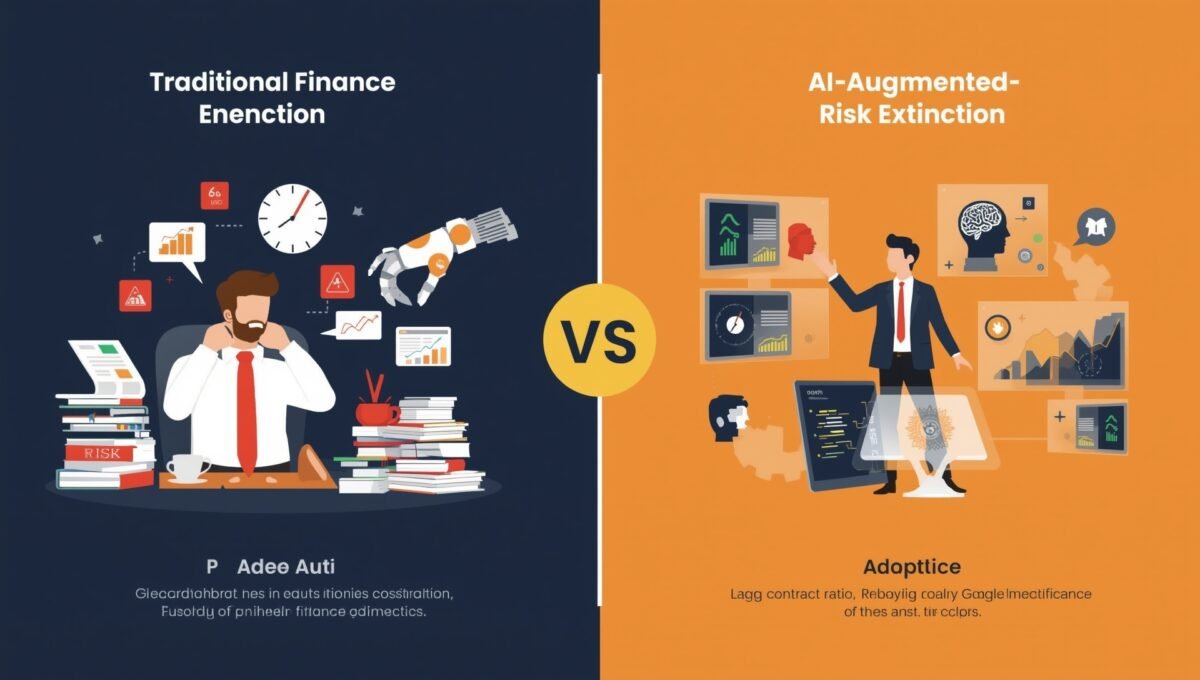
Few industries feel the pressure of artificial intelligence more acutely than finance. Headlines about machines replacing workers land hard when your career was built on years of training, and the anxiety is real. But the honest answer to whether finance jobs are at risk is not a simple yes or no. Some roles are genuinely exposed; others are fundamentally human and, in many cases, made stronger by AI. Knowing which is which is what actually protects your career.
Where finance already runs on AI
This is not a future scenario — it is happening now, at scale. Major institutions are pouring money into automation that streamlines operations and cuts cost, and the shift is well underway. AI already handles document processing and data extraction, basic financial analysis and reporting, fraud detection and risk scoring, customer-service chatbots, trade execution, and compliance monitoring.
The concrete examples are striking. JPMorgan’s COIN program reviews legal documents that once took an estimated 360,000 hours of lawyer time a year, doing it in seconds with fewer errors. Goldman Sachs famously pared a stock-trading desk that once employed around 600 traders down to a handful, replaced largely by algorithms. Bank of America’s Erica assistant handles vast volumes of customer interactions, and BlackRock’s Aladdin risk platform helps oversee trillions of dollars in assets. Finance leads most industries in AI adoption for a reason.
McKinsey research pegs the global AI-in-finance market in the tens of billions of dollars and finds financial services out in front on adoption, with banks reporting meaningful cost reductions from automation. (Source: McKinsey.)
The roles most exposed
The pattern is consistent: the more routine and repetitive the work, the higher the exposure. Data-entry and processing roles sit at the top, since AI reads and inputs information faster and more accurately than a person can. Basic financial-analysis positions are close behind — junior work like standard ratio calculations, trend analysis, and boilerplate report generation is exactly what machine-learning models do well, a point Oxford researchers have made in their analysis of automation. Banking customer-service roles are being absorbed by increasingly capable chatbots, and accounts-payable and receivable clerks face pressure from optical character recognition and payment systems that plug straight into accounting platforms.
Timing varies. The nearest-term disruption hits data entry, basic bookkeeping, and simple customer service. Over the next few years, junior analyst work, compliance monitoring, and credit processing come under pressure, with mid-level analysis and specialized reporting following further out. Geography matters too: the big US financial centers move fastest, while smaller markets and more cautious regulatory environments lag. Accounting is squarely in this trend, with software steadily taking on tax prep, bookkeeping, and routine auditing.
The roles AI can’t touch
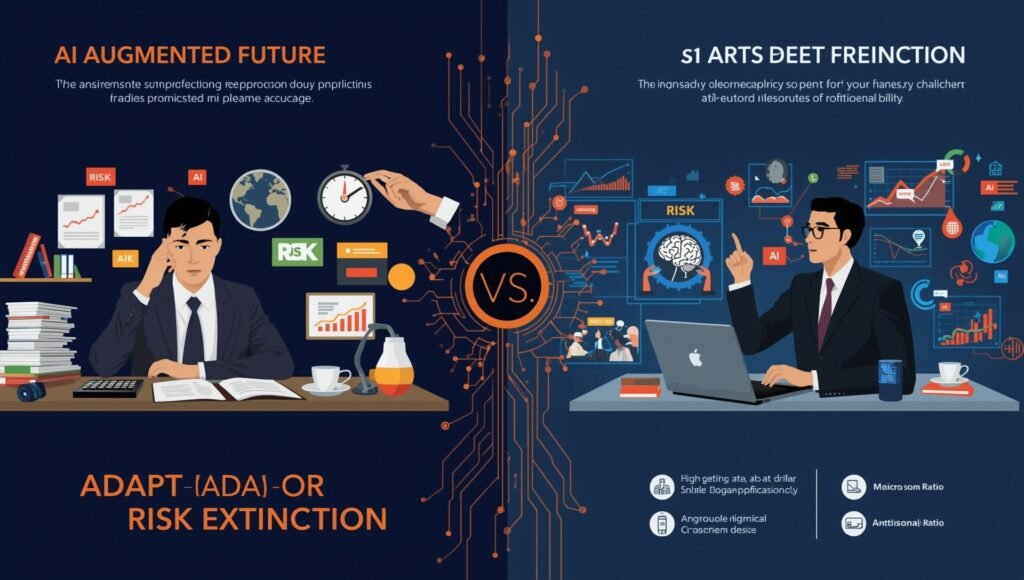
Plenty of finance work stays firmly human, and some of it gets better with AI in the toolkit. Strategic financial planning depends on judgment — reading market conditions, weighing a competitive landscape, managing stakeholders — that machines do not replicate. Client relationship management in wealth and advisory work is built on trust and empathy; high-net-worth clients want a person, with AI providing analysis in the background rather than replacing the relationship. Complex, one-off situations like mergers, acquisitions, and restructuring reward creative thinking and negotiation, precisely where pattern-matching struggles. And compliance leadership requires interpreting evolving rules and making ethical calls, with regulators often insisting on human accountability.
Many roles will not vanish so much as change shape. Financial analysts spend less time gathering data and more on interpretation and recommendations. Risk managers gain powerful modeling and stress-testing tools while still guiding the analysis. And entirely new jobs are emerging around the seam between finance and technology — AI finance specialists, financial data scientists, AI ethics and governance roles, human-AI process designers, and fintech implementation consultants.
How the sectors differ
Exposure is not uniform. In investment banking, junior tasks like pitch-book prep and data compilation are highly automatable, while deal structuring, client relationships, and negotiation stay human-led. Retail banking sees heavy customer-facing automation — basic teller and service roles decline — but complex problem resolution and personal banking hold their human requirement. Insurance is transforming fast at the routine end, with claims processing and junior underwriting exposed, while nuanced risk evaluation and specialized product work remain expert domains. Financial planning and advisory services are among the most resilient, since comprehensive wealth, estate, and tax planning are exactly the life-changing decisions people want a human advisor for. Accounting splits by specialization: routine bookkeeping and tax prep are automatable, but forensic accounting, complex audit interpretation, and advisory stay human-centric.
How to stay on the right side of it
Adapting is less about outrunning AI than positioning alongside it. Technology literacy — understanding what these tools do, where they fail, and how to apply them — increasingly separates the professionals who thrive from those who stall, and it does not require becoming a programmer. Data interpretation grows more valuable as AI produces more analytical output that someone still has to make sense of, spot anomalies in, and translate into decisions. Strategic thinking, complex reasoning, and scenario planning remain distinctly human, and the ability to communicate AI-generated insight clearly to non-technical stakeholders becomes a real differentiator.
The formal paths are catching up too. The CFA program has added AI and big-data content, the FRM certification now covers AI risk tools, and CPA requirements increasingly include data analytics. But the durable skill is the mindset: learning to collaborate with AI rather than compete against it, pairing its speed and pattern recognition with your creativity and judgment, and treating ongoing education as a permanent part of the job rather than a one-time box to tick.
What the forecasts actually say
The research consensus points toward transformation more than wholesale elimination. McKinsey has estimated that a significant share of finance tasks — roughly a third — could be automated by around 2030, while stressing that this reshapes jobs rather than deleting the category. Deloitte frames the impact in waves, moving from routine tasks to analysis and eventually toward decision support, each wave opening adaptation opportunities for those who prepare. Oxford’s work places the highest risk on junior, repetitive roles and the lowest on senior positions built around creativity and relationships. And bodies like the World Economic Forum expect the sector to generate substantial new employment even as automation advances, concentrated in human-AI collaboration, governance, and complex problem-solving. Adoption pace varies by region, with North America aggressive, Europe more measured on regulatory grounds, and Asia mixed.
The employer response reinforces the point. JPMorgan Chase has committed hundreds of millions of dollars a year to employee training aimed at moving staff into AI-augmented roles rather than out the door, and firms like Goldman Sachs have built internal AI academies to reskill existing employees. The through-line in real career transitions is consistent, even without naming individuals: the analyst who adds data-science skills moves into AI strategy work, and the auditor who layers machine-learning tools onto forensic expertise commands a premium. Professionals who combine finance depth with AI fluency tend to see clear salary advantages, because that hybrid skill set is genuinely scarce.
The bottom line
So, are finance jobs at risk from AI? Some are, meaningfully — the routine, entry-level, repetitive ones. But strategic, relationship-driven, and judgment-heavy roles are secure and often enhanced. Your security lies not in avoiding AI but in learning to work with it: build technology literacy, lean into strategic and relationship-intensive work, and keep learning. Treat AI as a powerful tool and supply the uniquely human value on top of it, and the AI era becomes an opportunity rather than a threat. For a related read, see our guide to building trading strategies with AI.
FAQs
Will AI replace financial analysts completely?
No, though junior analyst work faces high automation risk. Senior analysts focused on strategy, interpretation, and client relationships stay valuable and often find their capabilities enhanced by AI.
Which finance jobs are safest from automation?
High-level strategy, complex client relationship management, creative problem-solving, and roles requiring ethical judgment are the most protected.
How long do I have to prepare?
Entry-level roles feel the impact within a few years; more complex positions have a longer window. Either way, the sensible move is to start preparing now.
Do I need to learn programming?
Some programming knowledge helps but isn’t mandatory for every role. Understanding AI capabilities, interpreting data, and strong strategic thinking matter more for most positions.
Is finance still a good field despite AI?
Yes. Overall finance employment continues to grow, and new AI-related roles are emerging. The key is positioning yourself for the evolving jobs rather than the disappearing ones.