Deploying an AI system can feel like handing your car keys to a brilliant driver who won’t tell you the route. The technology is powerful, but the decisions happen somewhere you can’t see, and that “black box” quality is a genuine source of unease — because a system you can’t inspect can quietly introduce bias or make consequential calls you can’t explain or defend later.
A framework for safe and ethical AI is how you trade that unease for confidence. It is less a set of restrictions than a blueprint for building systems you can actually stand behind: fair, accountable, and transparent enough to turn the black box into something closer to a glass one. Done right, it does not slow innovation down — it gives you the footing to move faster without walking into a disaster.
What “safe and ethical AI” actually means
At its core, it means building and running artificial intelligence so that it benefits people while minimizing harm. In practice that involves engineering for fairness through bias testing and mitigation, privacy-first data handling, explainability, continuous monitoring, and human-in-the-loop controls, all wrapped in clear governance and accountability. Rather than fencing innovation in, these principles act as guardrails and operating procedures — they translate abstract values into specific controls, audits, and responsibilities, so AI systems behave reliably and respect the people they affect.
It helps to place the term next to its two close relatives. Ethical AI is the “why” — the moral philosophy, the questions about what is fair and what impact a system will have on people. Responsible AI is the “how” — the concrete techniques and design choices that build those ethics into the system, so a principle like “be fair” becomes an actual practice of auditing data for bias and correcting it. And AI governance is the “what” — the formal structure of policies, review boards, and defined roles that keeps everyone consistently doing the responsible thing. Ethics without governance drifts; governance without ethics is box-ticking.
It is worth being clear about what this discipline is not. It is not a blocker to progress — the myth that ethics slows things down ignores that it prevents the catastrophic failures which really do halt a project for months. It is not a one-and-done checklist, but an ongoing commitment that has to adapt as the technology moves. And it is not purely a tech problem; it needs legal, HR, leadership, and marketing at the table, not just engineering.
The five pillars of trustworthy AI
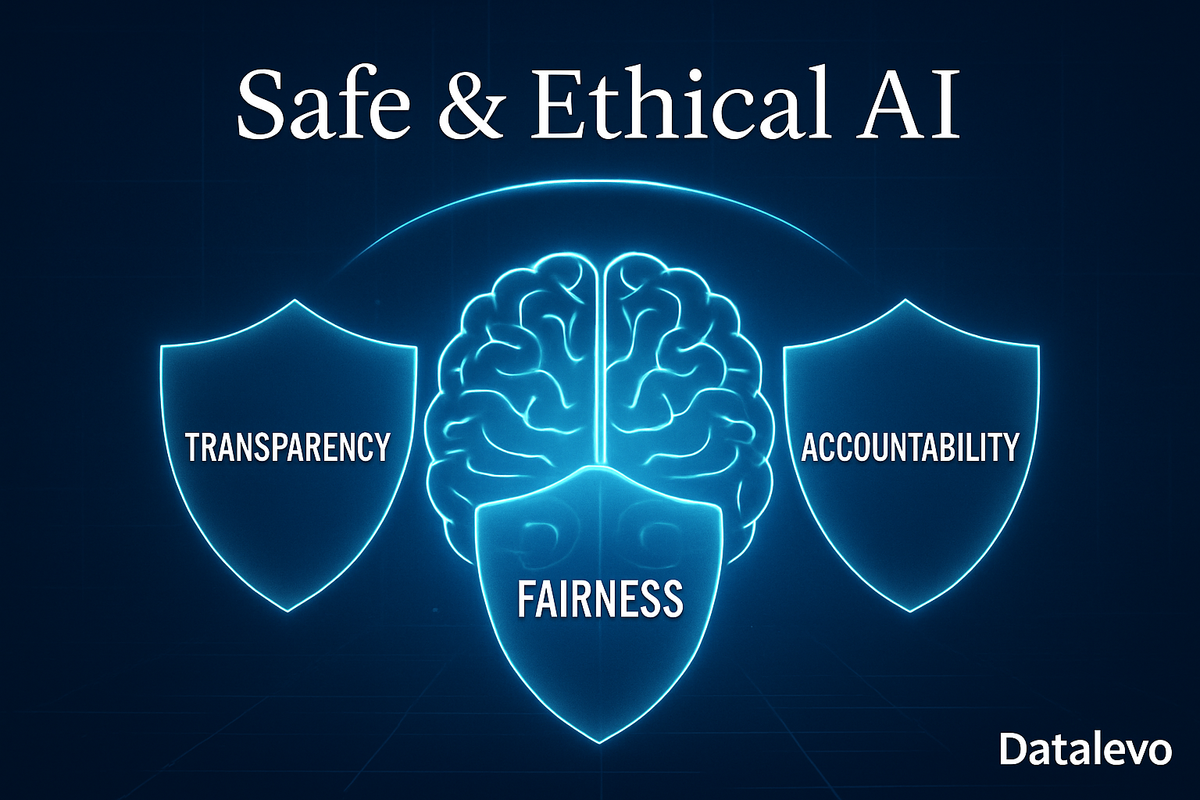
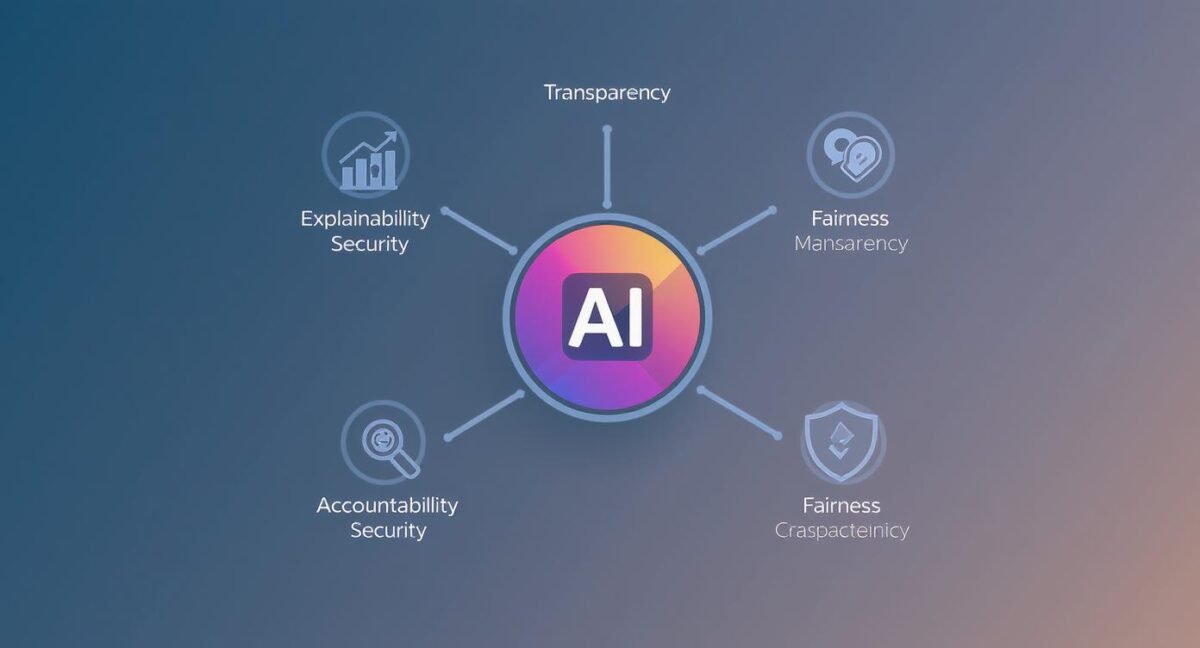
If safe and ethical AI is the goal, these five pillars are what hold it up. Across the organizations that get this right, the same foundations tend to appear, and getting them in place is the difference between an AI strategy that inspires confidence and one that generates constant anxiety.
1. Transparency and explainability
Transparency comes down to being able to answer one question: why? Why was this loan denied, this ad shown, this scan flagged? If the only answer is “the algorithm decided,” you do not have transparency — you have blind faith. And the cost of blind faith is real: when a furious customer calls about a premium that just doubled and your agent can only say “the system made a decision,” you have lost both the customer and a chunk of your reputation. This is where explainable AI earns its keep, with techniques like surfacing the few data points that most drove a decision (“denied primarily due to a high debt-to-income ratio”), offering counterfactual “what-if” scenarios (“approved if the amount were 15% lower”), and integrating tools that generate those explanations automatically for auditors, support teams, and customers.
2. Fairness and bias mitigation
An AI system is only ever as unbiased as its training data, and since the world is full of historical bias, that data usually carries it. Fairness means acknowledging this and taking active steps so your artificial intelligence does not perpetuate or amplify it. The cautionary tales are well known — a hiring tool trained on a decade of a male-dominated company’s data that learned to penalize résumés mentioning “women’s” clubs. Managing this is an ongoing process: audit datasets before training for under- or over-representation and hidden proxies (a postal code standing in for race, say), decide what fairness actually means for your use case, and apply mitigation techniques to correct the biases you find.
3. Robustness and security
A trustworthy system has to be tough — reliable under unexpected conditions and secure against people trying to break it. The risks are not hypothetical: researchers have shown that a few well-placed stickers on a stop sign can fool a self-driving car’s vision system into reading it as a speed-limit sign, and similar adversarial weaknesses exist in fraud and medical models. Building robustness means stress-testing beyond standard accuracy, using edge cases, corrupted data, and adversarial examples to find breaking points before deployment; monitoring for model drift so a system trained on last year’s data does not quietly degrade; and wrapping strong cybersecurity around models and data pipelines to prevent tampering and data poisoning.
4. Privacy and data governance
Data is the fuel of AI, and it is often deeply personal, so the privacy pillar rests on treating that data with respect at every stage. Getting it wrong is costly in more than reputation — regimes like the EU’s GDPR and Singapore’s PDPA carry significant penalties for mishandling personal data, and a reputation for being careless is nearly impossible to repair once customers decide a service feels creepy. Good practice goes well beyond having a privacy policy: minimize data collection to only what the task needs, anonymize and strip out personally identifiable information wherever possible, and explore privacy-enhancing technologies such as federated learning, where a model trains on a device without the raw data ever leaving it, or differential privacy, which adds statistical noise to prevent re-identification.
5. Accountability and human oversight
This is the backstop. However autonomous a system is, it remains a tool, and a human or a designated group must stay ultimately accountable for what it does — “the computer did it” is never an acceptable answer. When a high-stakes system errs, denying parole or recommending a faulty treatment, there has to be a clear path to recourse, or you get a gap where everyone points fingers and no one owns the outcome. Accountability needs structure: human-in-the-loop review so an expert signs off on critical decisions before they take effect, a cross-functional governance board overseeing AI across its lifecycle, and meticulous documentation and audit trails so that when something goes wrong, you can reconstruct what happened, why, and who was responsible.
Why businesses can’t treat this as optional

For a long time, AI ethics was treated as an academic nicety. That framing no longer holds. Ignoring the ethical dimension is not a neutral stance; it is a direct business risk, because a company’s approach to AI increasingly shapes its brand as much as its customer service or product quality does. Picture two online retailers: one uses AI to make genuinely helpful recommendations, the other pushes invasive, eerily personal ads and manipulates pricing from user data. Customers are getting sophisticated about how their data is handled, and surveys across the industry consistently find that people lean toward brands they see as transparent and ethical in their use of AI. Falling short of that expectation quietly drives customers to competitors.
The economics also favor prevention. The perceived cost of standing up an ethics board and running audits looks trivial next to a single major failure: multi-million-dollar fines under frameworks like GDPR or the PDPA, class-action lawsuits over discriminatory outcomes, a stock hit after a public scandal, and the slow, sometimes permanent erosion of customer trust. That is what risk management here really is — spending a little now to avoid a catastrophe later. Governments are moving in this direction too; Singapore’s AI Verify Foundation and Model AI Governance Framework are examples of the kind of standards worth aligning with, both as good practice and as a signal to the market.
Talent is the third pressure. The competition for strong data scientists and ML engineers is fierce, and the best of them increasingly ask hard questions about a company’s ethical guardrails and data practices in interviews. Between an employer that is vague about its policies and one that can point to a clear ethical framework and governance structure, the choice is not close. A demonstrated commitment to ethical technology has become part of the employer brand, not a footnote to it.
Lessons from the real world
Theory only goes so far; the case studies teach the rest. On the positive side, Salesforce built an Office of Ethical and Humane Use, publishing scorecards and impact assessments and folding ethics into product development from the start rather than bolting it on later — turning trustworthiness into a feature of the brand. As a cautionary tale, Amazon famously scrapped an AI recruiting tool after finding it was heavily biased against women; trained on a decade of mostly male résumés, it had taught itself to penalize applicants from women’s colleges. It is a sharp reminder that historical data can quietly produce discriminatory and reputation-damaging outcomes.
The takeaway
We started at the black box and its uncertainty. Working through the five pillars — transparency, fairness, robustness, privacy, and accountability — is how that box becomes a glass one. An ethical AI framework is not about limiting innovation; it is about unlocking it responsibly. It is also strategic: in an era where trust is the scarcest asset, a visible commitment to safe and ethical AI is what attracts talent, earns loyal customers, and builds a business ready for what comes next. For more on where this plays out, see our overview of AI use cases by industry.
FAQs
What’s the first step to making our AI more ethical?
Form a cross-functional AI ethics team. Bringing together legal, tech, HR, and business leadership from the start gives you a balanced view of the risks and builds ethics into your foundation rather than bolting it on later.
Can an AI system ever be completely free of bias?
Realistically, no. Because AI learns from real-world data that already contains bias, eliminating it entirely is close to impossible. But careful data audits, mitigation techniques, and continuous monitoring can significantly reduce it and keep outcomes fair.
How does ethical AI benefit a company’s bottom line?
It lowers the risk of costly fines and lawsuits, builds the customer trust that drives retention, and makes the company more attractive to the top talent who fuel innovation.
What’s the difference between ethical AI and responsible AI?
It’s the “why” versus the “how.” Ethical AI is the moral philosophy — the principles you hold. Responsible AI is putting those principles into practice through specific tools, processes, and design choices.
Does building ethical AI slow innovation down?
Not in practice. Clear guardrails give teams the confidence to experiment safely, and they head off the catastrophic failures that can stall a project for months or years.